Wildlife Wednesdays: Superb Lyrebird
by Olivia Maciejewski
Scientific Names: Menura novaehollandiae
Classification:
- Kingdom: Animalia
- Class: Aves
- Family: Menuridae
Population Number: Unknown, decreasing
Superb lyrebirds are well-known for their communication skills and their mating rituals to attract the ladies. Around 80% of the superb lyrebird’s songs are mimicry. They are able to imitate all sorts of noises that they hear around them including chainsaws, car engines, dogs barking, and other bird calls. They also have their own series of whistles and cackling noises that they make as a territorial call, and a loud alarm shrieks when they are in danger. Their mimicry songs can last up to 20 minutes.
Their mating season starts anywhere from as early as April and as late as June, lasting until October, when the young hatch. The male superb lyrebirds secure a territory, building mounds of dirt to use as a podium. Then the males will stand on the mound of dirt and sing and dance, moving around their luscious tail feathers, attracting many female mates. These males can mate with multiple females during the mating season. It is then the female’s job to build a cozy nest either on the forest floor, a rock, tree stumps, or even in small caves/boroughs. Their nests are typically made out of sticks and have a soft layer of fern, roots, and even feathers to incubate the egg. At one given season, females will only lay one egg which is brown and purple in color. The female will then sit on the egg for about 50 days before it hatches.
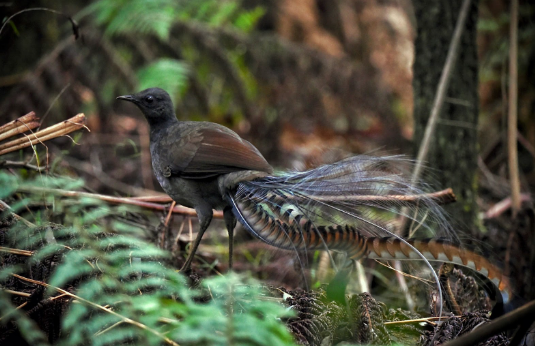
Superb lyrebirds are larger birds compared to a sweet hummingbird, but much smaller than the flightless ostrich. These birds are around 80 cm to 100 cm long, including their long, lyre-like tails. The male superb lyrebirds have ornate and decorative tails with special curved feathers that form the shape of a lyre, an ancient Greek musical instrument. The top layer of feathers are brown, whereas there are sublayers of silver and gray feathers below. Young male superb lyrebirds do not grow their lyre-like tail until they are 3-4 years old. Female superb lyrebirds also have the long brown feathers, but lack the specialized grey and silver lyre feathers.
In general, both sexes of the superb lyrebirds have black beaks, legs, and feet. They have brown feathers marking their upper bodies, and lighter brown and even red feathers marking their throats and sides.
These birds are found in South-eastern Australia and southern Tasmania. Their habitats include moist forests and woodlands. Here they will scrounge and forage for food during the day, and roost in the trees during the night. These birds rarely move long distances and stay within a 10 kilometer radius of their preferred habitat. Superb lyrebirds have the ability to fly; however, they only do if they are escaping immediate danger. Other than that they flap their feathers for the sake of female attention.
Superb lyrebirds’ diet consists of various things found on the forest floor. They eat insects, spiders, worms, and small seeds. Instead of using their beak to pick at these, they scratch their claws under the leaf litter to discover what they want to eat. These birds tend to eat alone, and are more independent creatures; however, when they are young, they tend to stick together for a bit.
Unfortunately, superb lyrebirds have already been driven towards extinction once, due to habitat clearing and illegal hunting for their silver lyre tails. While they are no longer an endangered species, they still remain under threat by large wildcats and foxes, as well as human developments disturbing their habitats. Despite their decreasing population size, these birds can live up to 20 years old, a rather average lifespan for these medium sized birds.
For more information about superb lyrebirds, check out our sources:
Leave a Reply