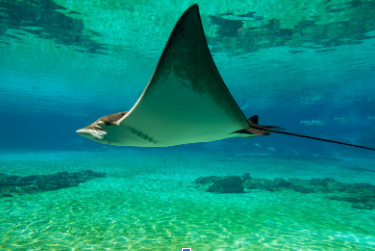
Wildlife Wednesdays: Giant Oceanic Manta Ray
by Madeline Davis
Scientific Name: Mobula birostris
Classification:
- Kingdom: Animalia
- Class: Chondrichthyes
- Family: Mobulidae
Population Number: Unknown but Endangered
The giant oceanic manta ray is the largest type of ray in the world, and one of three formally recognized manta ray species. Manta rays are recognized by their diamond-shaped bodies and elongated pectoral fins. Their eyes and spiracles are on the side of their heads, while their gills are located on the underside of their bodies. Rays have a terminal mouth and two cephalic lobes at the front of their bodies. These lobes are used for feeding, helping the rays to funnel water and plankton into their mouths. They can even be used for sensory detection and maneuvering, making manta rays the only vertebrate animal with three paired appendages. Unlike the closely related devil rays, the manta ray does not have a spiny tail. Rather, it has a knob–like bulge at the base of its tail that houses its vestigial spine.
Giant manta rays are specifically identifiable due to the coloring of their smooth skin. The dorsal fins are usually black, dark brown, or a dark blue, with the top of the head and underbelly being white. These rays can have pale spots located around the top of their body, and darker ventral spots clustered around the lower abdominal region. Despite this clear coloring pattern, the giant ray can be confused with the reef manta ray (M. alfredi) due to their similar appearance. However, there is one clear difference between the two species: their size. As previously stated, giant manta rays are the largest manta ray species. The ray can grow up to 30 ft. in length and have a disc size of 23 ft. across. Adult giant manta rays typically weigh between 3,000 – 4,000 pounds, but they can weigh over 5,000 pounds. Giant rays also have the largest brain of any fish, weighing up to 200 grams!
The giant manta ray is found worldwide across tropical and temperate water. It is commonly found offshore, traveling with the currents to different areas. The timing of its migration can depend on many different factors, including the movement of zooplankton, seawater temperatures, tidal patterns, season upwelling, and mating behavior. In deep water, the giant manta ray swims steadily in a straight line, swimming at speeds up to 15 miles per hour. When it is further inshore, it will swim idly through the water. They also swim slowly when capturing prey.
Giant oceanic manta rays feed on planktonic organisms. This commonly includes shrimp, euphausiids, copepods, and decapod larvae, but they eat small sized fish as well. When feeding, manta rays will move their cephalic lobes into an “O” shape and open their mouths wide. This creates a funnel that pushes water and prey through its mouth. Rays can do this alone, or in large groups by creating feeding chains with other mantas. Giant manta rays can be found in a group of up to 50 rays. When these large groups feed, they swim slowly around their prey to herd the planktonic creatures into a tight group. They then speed through the group, catching the food in their open awaiting mouths.
Another interesting thing about the giant oceanic manta ray is that they sometimes will visit a cleaning station on a coral reef. They allow their body to become still for several minutes to allow cleaner fish the ability to consume pieces of loose skin and external parasites. These cleaning stations can exist in both freshwater and marine environments, and in addition to manta rays, cleaning stations can be used by fish, sea turtles, or even hippos!
There are many different factors that contribute to the endangerment of giant oceanic manta rays. The first is natural predation. Due to the ray’s size and speed, they do not face as many predators as some other manta ray species. However, large sharks, killer whales, and dolphins are capable of preying on them. Nonlethal shark bites are actually very common, and many adult rays will have scars from at least one attack!
The most significant threat to the giant ray population is overfishing. Giant rays feed in shallow water, which means they can be easily caught as bycatch by global fisheries. But these rays are not just caught on accident. Since the 1970s, fishing for manta rays has significantly increased due to their gill rakers being used in a traditional Chinese medicine. In Chinese culture, the ray’s gills are the main ingredient in a tonic called peng yu sai, which is marketed to help reduce toxins and enhance blood circulation, as well as help cure a number of other ailments. However, none of these claims are supported by science or in traditional Chinese medicine texts. Researchers estimate that this market for gill rakers is at least 61,000 kilograms per year.
Pollution is also a big factor in the declining population number for giant manta rays. Due to their filter-feeding method of catching prey, rays are at a higher risk of consuming microplastics. These microplastics can contain harmful pollutants and when digested, can create a variety of both long and short-term effects. Short-term effects include the reduction of bacteria in their guts, while long-term effects include the weakening of their population’s reproductive fitness over future generations. This can severely negatively affect population levels of the giant rays in the future.
In 2011, the giant oceanic manta ray was added to the International Union for Conservation of Nature and Natural Resources’ Red List of Threatened Species. Although they were listed as endangered, there is very little international protection for these species. However, there are ways that you can help! The biggest way is to reduce ocean pollution. Make sure to recycle and try to limit your plastic usage. If you can, you could even participate in coastal clean-up events to help make our beaches and oceans cleaner! Also make sure to follow Manta Ray Safe Handling and Release Guidelines, and to report giant manta ray sightings when you see them!
For more information about giant oceanic manta rays or to how you can help with their conservation, see our sources:
- https://www.mantatrust.org/mobula-birostris
- https://en.wikipedia.org/wiki/Giant_oceanic_manta_ray
- https://www.fisheries.noaa.gov/species/giant-manta-ray
- https://www.scientificamerican.com/blog/extinction-countdown/manta-rays-endangered-by-sudden-demand-from-chinese-medicine/
- https://mantarayadvocates.com/why-do-manta-rays-twirl-when-they-feed/
Leave a Reply