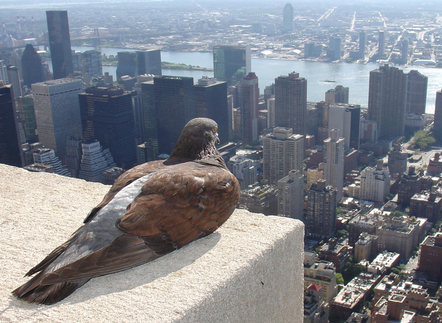
When Urbanization and Nature Collide
By Trinity Noelle Trimmer
New York City is home to over eight million people, making it one of the largest cities in the world. Its crowded streets are filled with a plethora of restaurants, small and large businesses, apartment buildings, festivals, taxis, and parks. Yet despite there being such a large quantity of human-made establishments and infrastructure, other organisms are still able to create their own ecosystems, adapting to coexist with the concrete jungle. One prominent animal most New Yorkers have grown quite familiar with is the pigeon.
At first glance, urban landscapes might not seem all that welcoming to wildlife given the copious amounts of pollution and oftentimes limited greenery. However, one thing that makes cities a perfect place for animals like pigeons to thrive is the lack of predators. There aren’t many foxes or large snakes roaming the streets of New York, making it an ideal place for pigeons to reproduce. The city even offers perfect nesting sites for pigeons in the form of fire escapes, parapets, and ledges. These various nooks and crannies offer pigeons a safe place to call home and raise their young. Additionally, there is a surplus of food for pigeons to feast on all around the city. While they would normally eat berries and seeds in the wild, urban pigeons have easy access to what is essentially an all-you-can-eat buffet from scraps left behind by street vendors and trash cans practically overflowing with crumbs.
There are both pros and cons to pigeons living in urban environments. Pigeons eat a lot of seeds and oftentimes these seeds are undigested, even as they pass through the pigeons’ feces. Surprisingly enough, pigeon poop has led to an increase in vegetation across New York from rooftops, walls, and even in the cracks on the sidewalk. They also eat various insects which helps control the populations that some may consider pests. However, like many other birds, pigeons are known to carry various diseases that can be passed on to humans, making it crucial to limit direct contact with pigeons. And while pigeon poop has its benefits, it is acidic and can cause damage to certain materials on buildings.
Pigeons have thrived in New York City for quite some time, but it is important to note that some New Yorkers have not been so pleased with their avian neighbors. The city has strived to focus on humane ways of managing the growing population, advocating for catching pigeons with traps that have one-way doors and relocating them outside the city. Some people have even favored having special spikes and netting installed on their buildings. It is illegal to intentionally kill pigeons in New York City as the city condemns cruelty against animals and worries about health risks that can be caused by dead birds. However, these methods of managing the population continue to persist, creating an uprising in considering more ethical solutions.
Many city residents appreciate the presence of pigeons and strongly believe they have rights too, leading to efforts that don’t involve controlling them, but rather, changing human behavior. One potential solution to control the population is to reduce littering in the city, as well as make trash cans less accessible to the birds. There has been an increase in educating the public about feeding pigeons, discouraging both local residents and tourists from feeding them. This not only helps to control a small fraction of urban pollution, but also deters pigeons scavenging for food. When the food supply becomes depleted or limited in one place, animals will be more inclined to migrate to another.
Overall, pigeons are an integral part to New York City’s ecosystems and their resilience in urban environments shows just how adaptive animals can be when nature and human-made infrastructures collide. While there are still downsides to urbanization and concerns over the impacts it has on nature, the pigeons of New York are a sign of hope. Hope that humans can not only peacefully coexist with nature, but share mutualistic relationships with the organisms around them.
Sources:
- https://www.pigeonpatrol.ca/predators-of-the-pigeon/
- https://bestatpestnyc.com/pigeons-in-new-york-managing-the-citys-most-ubiquitous-birds/
Image Taken From (with Creative Commons License): https://en.wikipedia.org/wiki/Birding_in_New_York_City
Leave a Reply