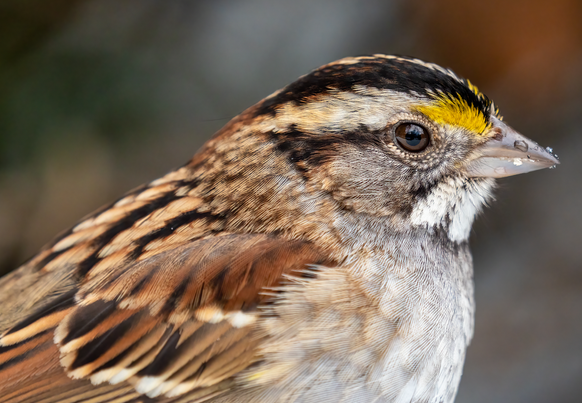
Sex and Gender of the White-Throated Sparrow
by Emma Dickinson
Common Name: White-throated sparrow
Scientific Name: Zonotrichia albicollis
Classification:
- Kingdom: Animalia
- Class: Aves
- Family: Passerellidae
Population Number: low concern
The white-throated sparrow is a familiar bird across Pennsylvania. It is granivorous (eats seeds) and typically lives in forested environments. This simple seeming bird has an overlooked feature—it has 2 sexes, 2 genders, and 4 different combinations of the two.
In animal behavior, the term “sex” refers to the biological differences between individuals of the same species. Males have testes and females have ovaries. We use the term “gender” to refer to a suite of behaviors typically associated with a sex. In avian (bird) species, the male gender is usually characterized by more aggressive and flashy behavior while the female gender tends to be more docile and nurturing. The white-throated sparrow takes this construct, and laughs in its face.
White throated sparrows have two different color morphs: the white stripe and the tan stripe. Sex doesn’t determine the color morph, and there are biological males and females of both color morphs. White stripes are more aggressive, a behavior associated with males, and tan stripes are usually more nurturing, a behavior associated with females. So there are biological males with female genders, and biological females with male genders? Yup! There are also biological males with male genders, and biological females with female genders.
The birds almost always form heterosexual mating pairs with opposite morphs. Each pair has a white, aggressive type and a tan, nurturing type, and it doesn’t matter what sex plays which role. In this species, biologically male birds can be the ones feeding the young diligently while their biological female mate kicks the butts of intruders.
“Sex” and “gender” are artificial terms that allow us to categorize and convey the behavior of animals, but science teaches us that none of it is standard across species. White-throated sparrows are unique birds which very clearly demonstrate this principle. As a matter of fact, plenty of species fall outside the framework of human-invented traditional sex and gender norms. Some fungi have over 17,000 sexes. Ruffs, another avian species, have 2 sexes and 4 gender expressions. 31% of albatross nesting pairs are same-sex.
Diversity is what makes our planet strong, and when we look to the natural world—which we are a part of—we see an amazing range of behaviors, group dynamics, and ways of being.
For more information about white-throated sparrows, check out our sources:
Gaines, James M. “This Fungus Has More Than 17,000 Sexes.” The Scientist, 2025, the-scientist.com/this-fungus-has-more-than-17-000-sexes-69930.
Kaufman, Kenn. “The Fascinating and Complicated Sex Lives of White-throated Sparrows.” Audubon, 29 Mar. 2017, audubon.org/magazine/fascinating-and-complicated-sex-lives-white-throated-sparrows.
Maney, Donna L. “This Backyard Bird Has a Lot to Teach Us about Sex Variability.” Scientific American, 18 Feb. 2025, scientificamerican.com/article/a-backyard-bird-offers-a-new-way-of-thinking-about-sexes/.
“Ruff Sex: Nature’s Most Gender-Fluid Bird.” The Guardian, 17 Nov. 2015, theguardian.com/world/shortcuts/2015/nov/17/ruff-sandpiper-gender-fluid-bird.
“Variety Matters Among White-Throated Sparrows.” North Country Public Radio, Natural Selections, 4 Sept. 2014, northcountrypublicradio.org/news/story/11424/20140904/variety-matters-among-white-throated sparrows. Zimmer, Carl. “Same-Sex Mothers: Letting Albatrosses Be Albatrosses.” National Geographic, 26 Nov. 2013, nationalgeographic.com/science/article/same-sex-mothers-letting-albatrosses-be-albatrosses.
Leave a Reply