By: Madeline Davis, researched by Hal Dittbrenner
Scientific Name: Coracias caudatus
Classification:
- Kingdom: Animalia
- Class: Aves
- Family: Coraciidae
Population Number: Stable
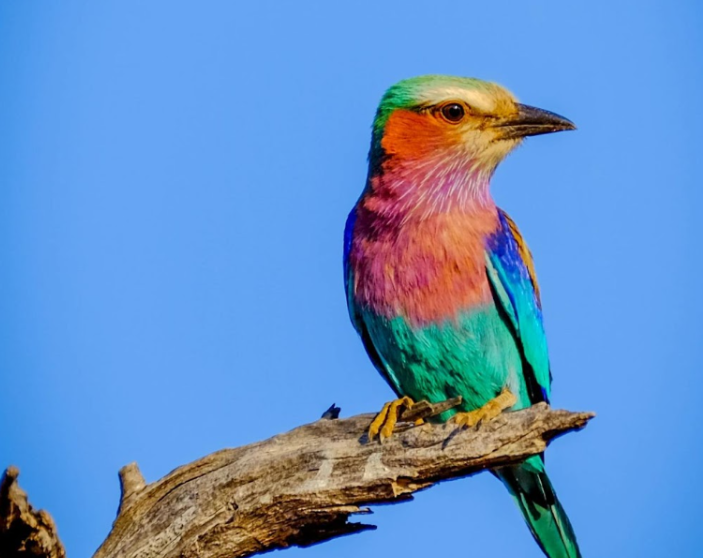
The lilac-breasted roller is a remarkable and unmistakable bird. With its highly colorful feathers, this bird is well known throughout Southern and Eastern Africa. This bird is the unofficial national bird of Kenya, and is called “Kambu” in Swahili. The lilac-breasted roller is also known as the fork-tailed roller, the lilac-throated roller, and Mosilikatze’s roller.
These rollers are not sexually dimorphic, so both male and females appear with the same colorful coat. However, its color is differentiable among its subspecies. Subspecies C. c. caudatus has a lilac throat that deepens into a darker lilac breast, with an olive color covering it from its crown to mantle. In subspecies C. c. lorti, the throat is still lilac, but the breast fades into a turquoise/azure blue color. The crown to mantle is a greenish blue instead of olive, and some will have either lilac or brown patches on the lower abdomen. Both subspecies have long, black outermost tail streamers. These tail streamers are only found in adults, and the absence of them can help people identify juvenile rollers.
Lilac-breasted rollers have an average weight of 104 grams. They are typically 14.2-15.0 inches in length and have a wingspan of 19.7-22.8 inches.. The lilac-breasted roller has a lifespan of about 10 years, both in the wild and captivity.
The lilac-breasted roller is indigenous to Southern and Eastern Africa. The bird prefers open woodland and savanna, and tends to avoid treeless areas. Generally, these birds also try to avoid highly human-influenced areas, and are not found in urban or rural sectors. The birds require high perches for nesting and feeding. It will use trees, poles, and even the backs of large herbivorous mammals to scout the ground below.
From its high advantage point, the lilac-breasted roller can survey the ground for its prey. The lilac-breasted rollers is a carnivore, and its diet consists of arthropods and small vertebrates. This includes insects, spiders, scorpions, centipedes, and snails. It will also eat small birds. The lilac-breasted roller is also an ambush predator. When it spots its prey from its perch, the bird will swoop down and grab the food in its beak. If the prey is small, like an insect, the bird will eat it on the ground. However, these aggressive birds will carry larger prey back to their perch. There, the bird will then beat the prey until it is dismembered to prepare it for consumption.
Lilac-breasted rollers get their name from their impressive courtship flight. During the breeding season, the male rises to a height of 69-144 meters (226-472 ft) and then descends in acrobatic swoops and dives, while uttering harsh, discordant cries. While leveling at its highest speed, the bird will roll to the left and right before swooping up again.
The birds are monogamous, and are believed to mate for life. The breeding season occurs at various times during the year, depending on the location. In Somalia, their breeding season is usually from late April to mid-September. Lilac-breasted rollers lay 2-4 eggs per season, which are then incubated by both sexes for 22-24 days. Chicks are born altricial, meaning that they are underdeveloped at the time of birth and need their parents’ assistance to mature. The chicks will become fully feathered after 18-20 days, but will remain dependent on their parents for up to another month. Most lilac-breasted rollers are ready to breed at the age of 2 years.
Pairs are extremely protective and territorial of their nest. They build unlined, grass nests inside hollowed out tree cavities and termite mounds. The rollers do not create these cavities themselves, and instead take over spaces previously hollowed out by woodpeckers and kingfishers. When intruders are near, one of the birds will fly in a rolling pattern as a territorial display above the nest to warn off the predators. The main predators the lilac-breasted roller faces are other birds of prey. This includes the bateleur, wahlberg’s eagle, the red-necked falcon, and the peregrine falcon.
According to the International Union for Conservation of Nature and Natural Resources (IUCN), the lilac-breasted roller is of least concern. It has a large, stable population size, and is widespread throughout its inhabited regions of Africa. With no major threats towards the lilac-breasted roller, the colorful bird continues to be a beautiful species and symbol of peace in Africa.
For more information about lilac-breasted rollers, check out our sources:
– https://en.wikipedia.org/wiki/Lilac-breasted_roller#
– https://app.birda.org/species-guide/10157/Lilac-breasted_Roller
Leave a Reply